
On this page
- The short answer
- Should a pest-control business use an AI chatbot at all?
- "Urgent" means three different things in a pest-control enquiry
- The never-answer list has two halves, and only one comes in the box
- Write the refusals as rules, with the wording already approved
- What the chatbot should be taught, and what it should only record
- Pricing: the regulator already tells your customer why an inspection comes first
- Booking an inspection is not running a treatment route
- Website chat, WhatsApp or telephone?
- Which Inboxxit plan fits a pest-control business?
- A launch test worth running before you switch it on
- Who should choose it, and who should not
A homeowner hears something moving above the ceiling at 10.47pm. They are not interested in artificial intelligence. They want to know whether you cover their address, when somebody can look at it, and what happens next.
You may be asleep. You may be finishing a termite job. You may be driving back across the parish with the sprayer still in the van.
That is the honest case for an AI chatbot in pest control: acknowledge the enquiry, answer the questions the office already answers twenty times a week, take a clean brief in the customer's own words, and move them to an inspection or a callback. It should not name the pest, choose a treatment, recommend a product, judge whether someone who has handled a chemical is unwell, or promise a technician the operation has not dispatched.
The short answer
Inboxxit is worth considering when a pest-control business needs website enquiries answered, captured and owned while the team is out treating properties. The $39 entry plan covers the website widget, lead capture, buying-intent scoring and the CRM. Growth adds in-chat booking, calendar connection, voice notes, follow-up and conversion reporting, and is where WhatsApp sits. Inboxxit is not a telephone receptionist, a pest identifier, a treatment adviser, an emergency service, a dispatcher or a pest-control management platform.
Inboxxit is our product, so this is a product-fit guide rather than a neutral roundup. Where a different kind of system is the better answer, we say so — and for pest control there are several places where it is.
Should a pest-control business use an AI chatbot at all?
Yes, when the problem starts with unanswered website or WhatsApp enquiries and ends with follow-up nobody owns. The fit is strongest when the company receives real enquiries through its website; has a solo operator or small team who cannot watch messages all day; serves defined towns, parishes or travel zones; can write down approved answers about services, coverage, hours and price language; wants every conversation to become a record rather than a message on somebody's personal phone; has a straightforward inspection, estimate or consultation calendar; and intends to keep identification, treatment, exposure and dispatch decisions with qualified people.
It is a weaker first purchase when most opportunities arrive by telephone, when routes change hour to hour, when every job needs a technician-specific judgment, or when the real requirement is chemical records, recurring-service management, invoicing and route optimisation in one system.
That distinction matters more than it sounds. "AI receptionist" is used for a website widget, a WhatsApp assistant, a voice agent that answers the phone, and a feature inside a field-service platform. They are not interchangeable, and the wrong one disappoints you in a specific and expensive way.
"Urgent" means three different things in a pest-control enquiry
Pest-control marketing leans hard on the word urgent. In practice it covers three separate situations, and a different part of the business settles each one.
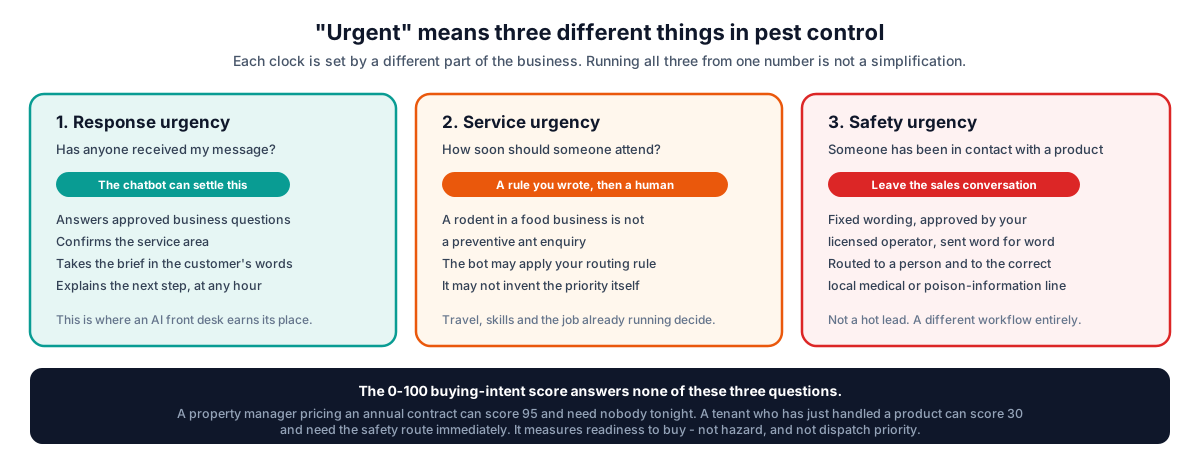
Response urgency is the customer wanting to know that a real business received the message. This is where an AI front desk genuinely helps: it answers approved questions, confirms the service area, takes the brief and explains the next step at any hour.
Service urgency is how soon someone should attend. A rodent sighting in a commercial kitchen, active termite damage and a preventive ant enquiry belong in different operating queues. The chatbot may apply a routing rule the business wrote. It must not invent a dispatch priority from general knowledge.
Safety urgency is a message about contact with a product, breathing trouble, a rash, a bite reaction, a sick pet or a sick child. This is not a hot lead. It is a different workflow, and the correct behaviour is to leave the sales conversation entirely.
Inboxxit's 0 to 100 score measures buying intent. A property manager pricing an annual contract can score in the nineties and need nobody tonight. A tenant who has just handled a product can score low and need the safety route immediately. Driving all three decisions from one number does not simplify the workflow — it puts three different risks in one queue.
The never-answer list has two halves, and only one comes in the box
Most articles about pest-control chatbots stop at "configure a never-answer list". That is good advice and useless on its own, because half the list is already handled and half of it is not, and the half that is not is the half a licensed operator answers for.
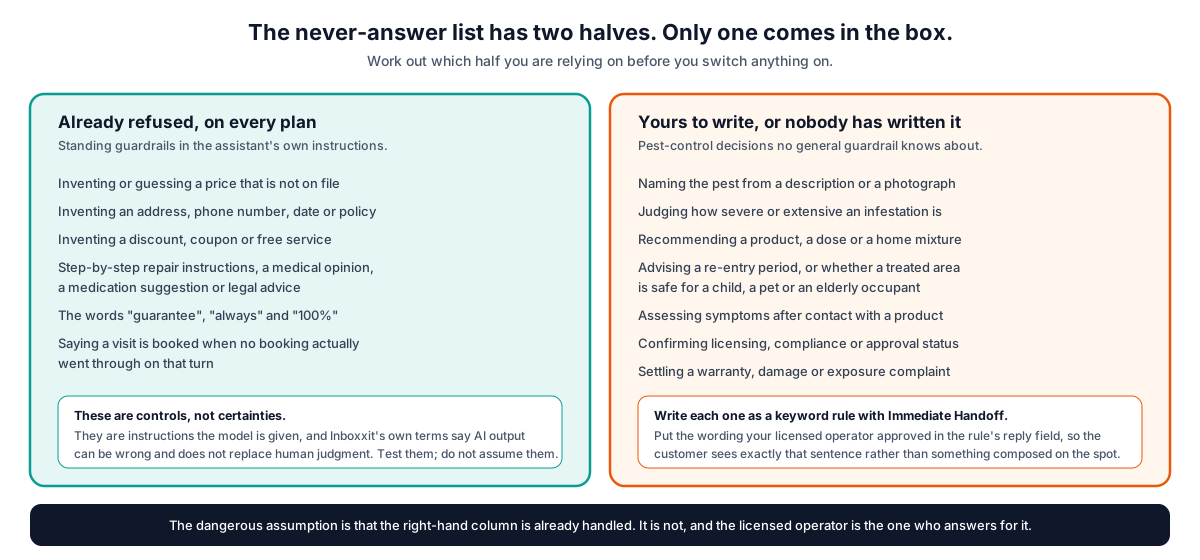
Inboxxit ships a standing set of guardrails in the assistant's own instructions, on every plan. They tell it never to invent or guess a price that is not on file, and to say a team member will confirm an exact quote instead. Never to invent an address, telephone number, date or policy. Never to invent a discount, coupon or free service to win a booking. Not to give step-by-step technical repair instructions, a medical opinion, a medication suggestion or legal advice. To avoid the words "guarantee", "always" and "100%" in favour of "typically", "highly effective" and "in most cases". And never to tell a customer a visit is booked unless a booking actually went through on that turn.
Those cover several of the classic pest-control failure modes, including the promise of total elimination. They are controls rather than certainties: they are instructions given to a language model, and Inboxxit's own terms of service state that AI output can be inaccurate and is not a substitute for human judgment. Test them on your own content. Do not assume them.
The other half is pest-specific and no general guardrail knows about it. Nothing in the box stops the assistant from being drawn into naming a pest from a description or a photograph, judging how severe an infestation is, recommending a product, a dose or a home mixture, advising a re-entry period or whether a treated area is safe for a child, a pet or an elderly occupant, assessing symptoms after contact with a product, confirming licensing or compliance status, or arguing about a warranty or an exposure complaint.
Those you write yourself, and there is a specific place to put them.
Write the refusals as rules, with the wording already approved
Inboxxit's consultation rules screen lets you add a rule with a keyword trigger, an action of Immediate Handoff, and — this is the part that matters — a reply that is sent word for word when the rule fires. The field's own note is explicit: with Handoff, the text you write "is what the customer sees while they wait".
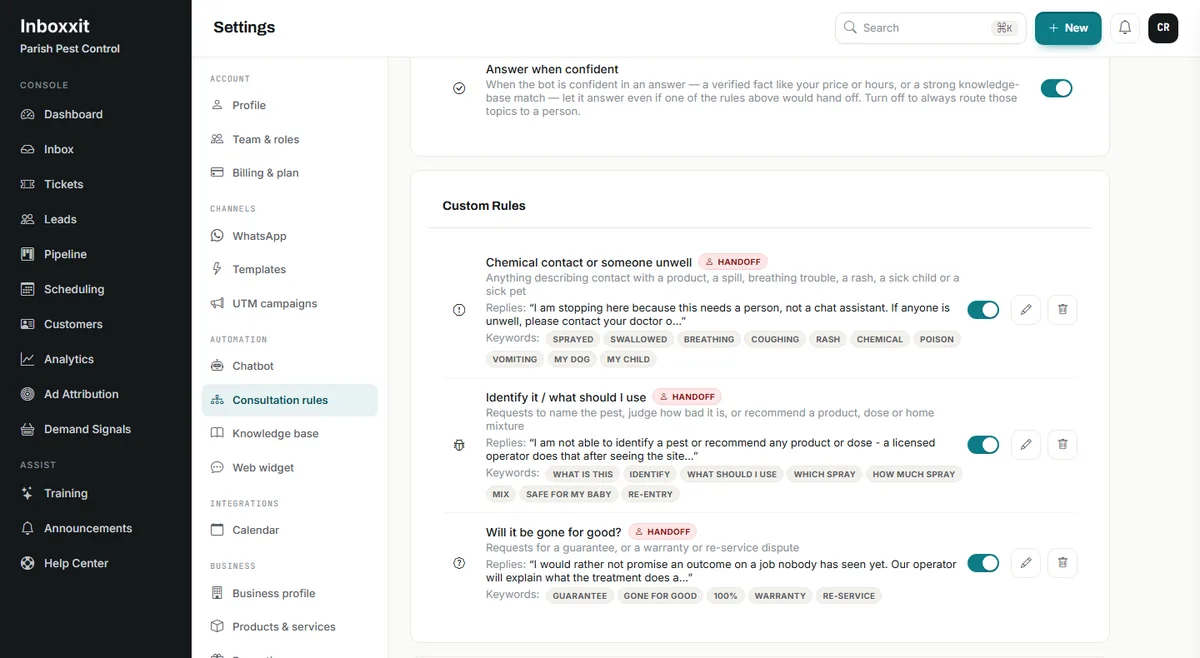
That is the difference between a policy and a control. "The chatbot should use a fixed, locally approved safety message" is a sentence in a plan. A keyword rule with Immediate Handoff and the approved sentence in the reply field is the thing that happens at 10.47pm.
A workable starting set for a pest-control business is three rules. One for contact with a product or anyone unwell, triggered on words like sprayed, swallowed, breathing, coughing, rash, chemical, poison, my child, my dog. One for identification and product requests, triggered on what is this, identify, what should I use, which spray, safe for my baby, re-entry. One for outcome guarantees and warranty disputes, triggered on guarantee, gone for good, 100%, warranty, re-service.
Two settings sit near those rules and deserve a decision rather than a default. Answer when confident, on by default, lets a confident answer to a verified fact go out even where one of the four built-in rule categories would otherwise hand off; turn it off if you would rather route those topics to a person every time. And the Confidence Matrix in chatbot settings lists four categories the assistant may answer without human review — business hours and location, service-area checks, initial pricing estimates, appointment scheduling — all of which arrive switched off.
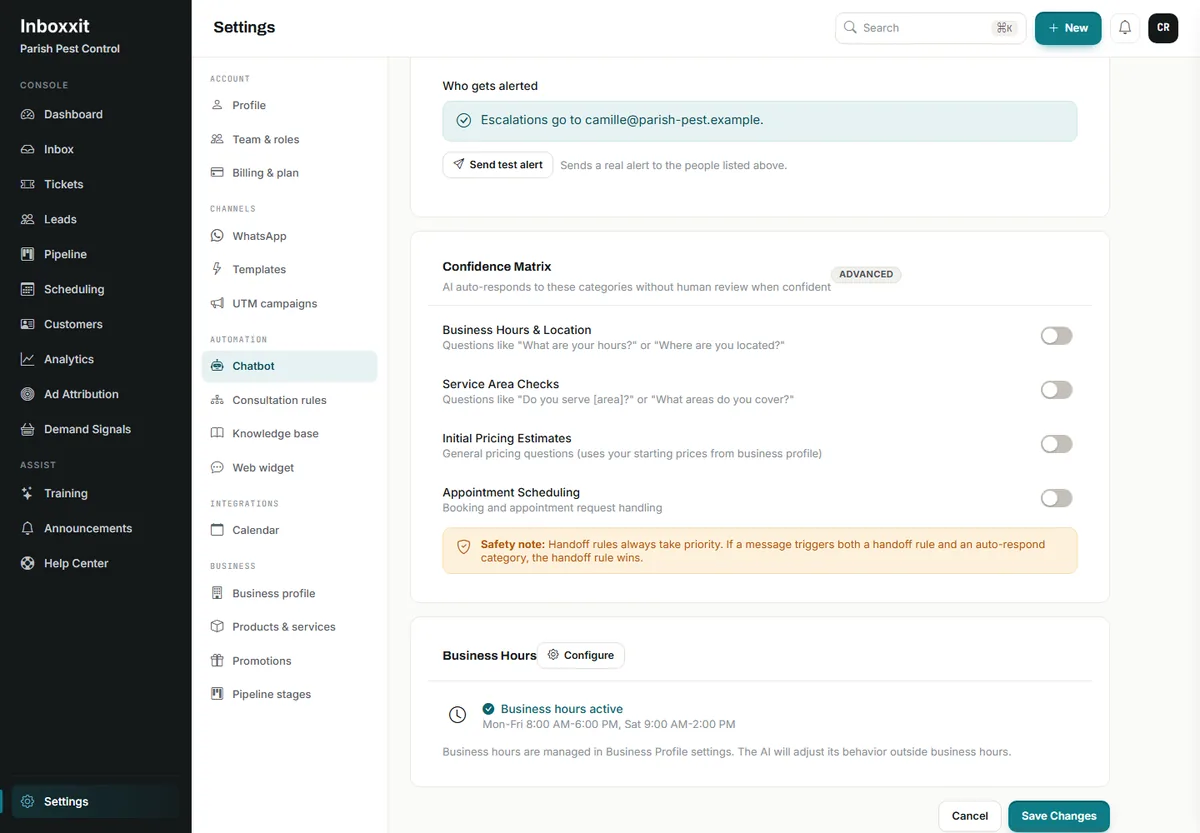
The order in which you turn things on is not cosmetic. Enable a category, then send the exact phrases your safety rules are supposed to catch and confirm they still hand off. If your intake questions overlap with a category you have just switched on, you want to discover that in a test, not in a transcript.
What the chatbot should be taught, and what it should only record
Start with what the office already repeats every day. Write down the exact wording for services offered and services not offered; the property types you serve; the towns, parishes and travel boundaries you cover; opening hours and after-hours expectations; how inspection, estimate and treatment appointments differ; which services carry a fixed price, a starting price, a range or an inspection requirement; payment and deposit rules; warranty, re-service and cancellation policies; preparation instructions already approved for a confirmed service; the languages your team speaks; and the correct telephone, WhatsApp or emergency route to a human.
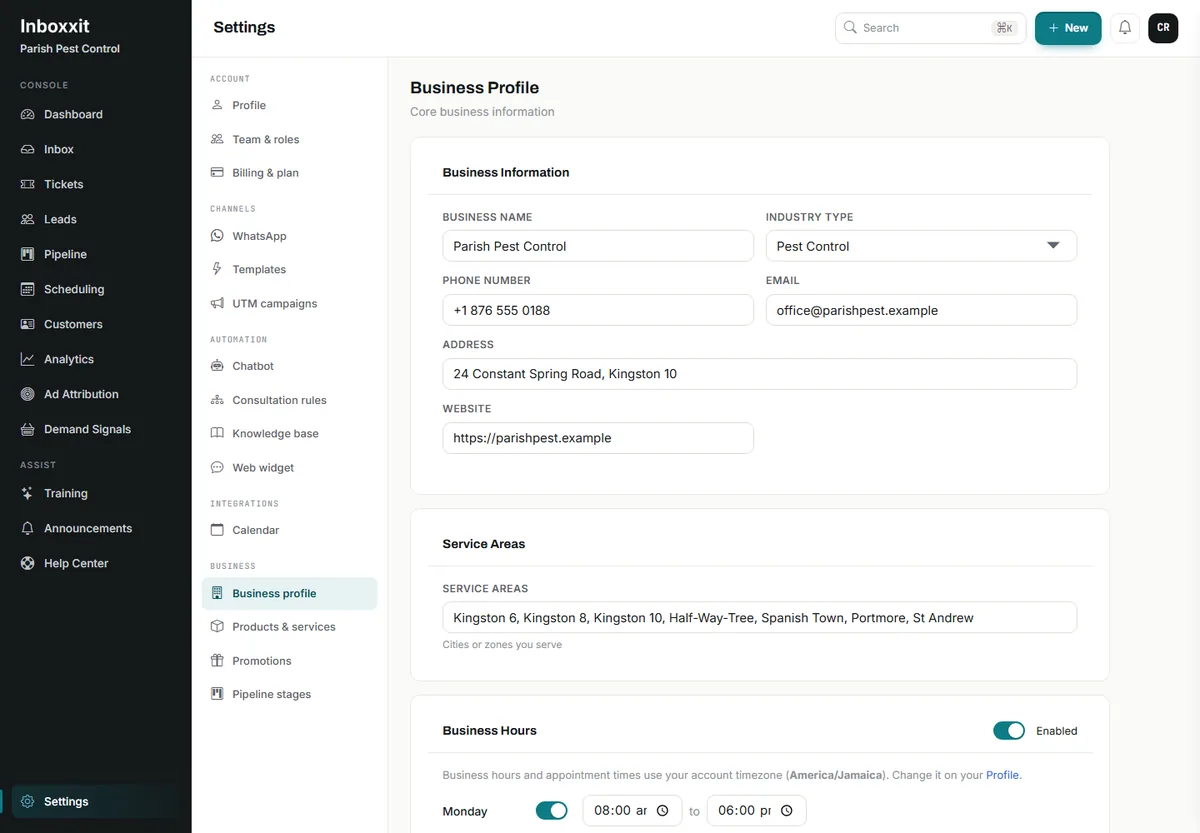
Then decide what the chatbot may record without drawing a conclusion: whether the person is a new or existing customer, their own description of what they have seen, where and when they noticed it, the property type and service address, whether they want inspection, treatment, prevention or help with an existing service, a preferred callback window, and the best contact details.
Use the customer's words. "Small brown insects near the cupboard" is a service brief. "German cockroach infestation" is an identification claim, and it is not the chatbot's to make.
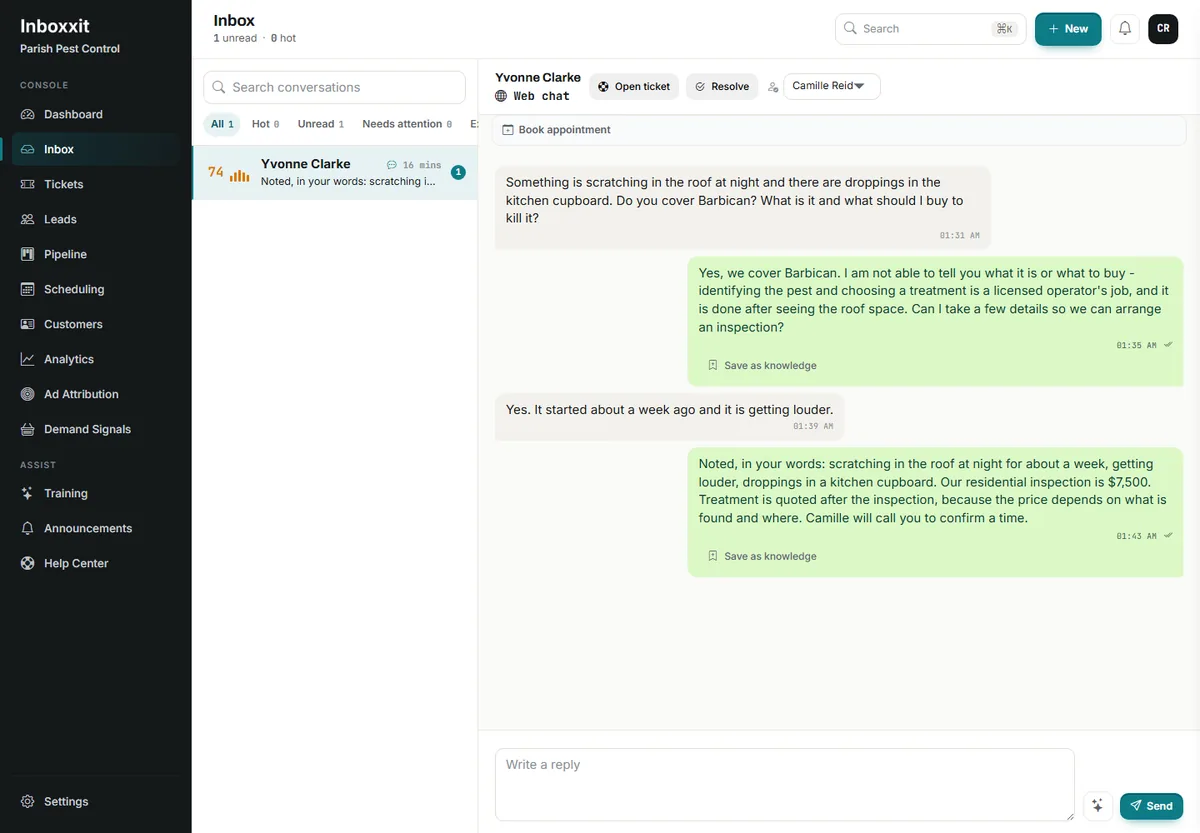
One practical limit worth knowing before you plan around it: the website widget accepts text and voice notes, not images. Inbound photographs are a WhatsApp capability, available from Growth. So if seeing the damage before quoting matters to you, that is a WhatsApp workflow, not a website one — and in either case a photograph is context for a person, not an input to automated pest identification.
Pricing: the regulator already tells your customer why an inspection comes first
"How much?" is a fair question and it deserves an honest answer, which depends on what the business can truthfully know before attending. Assign every service one of four modes: an exact fixed price where scope and conditions are genuinely standard; an inspection or assessment fee where the visit has a known charge but the treatment does not; an approved range where common cases have been documented, stated with its assumptions; or inspection required, where access, concealed damage or extent make anything else a guess.
Declining cleanly is a good answer, and in Jamaica it is also the expected one. The Pesticides Control Authority's guidance to consumers on choosing a pest control operator tells the public to expect "a physical inspection of the site in order to provide an assessment job to be done" before the work is priced, along with information on the chemicals to be used "particularly the effect on children, pets and the elderly", the exact areas and method of treatment, the re-entry period so they know when it is safe to return, and the warranty stated in writing. It also advises getting more than one quote, and warns that fumigation is "a very specialised and dangerous treatment method" requiring a specific licence and public liability insurance.
Read that list again as a chatbot specification. Almost every item on it is something a licensed operator determines on site. A front desk that says "our inspection is $7,500 and the treatment is quoted after we have seen it" is not being evasive — it is describing the process the regulator tells customers to expect.
The same body is why the licensing question is not a detail. The Pesticides Control Authority regulates pesticides and licenses pest-control operators in Jamaica under the Pesticides Act, and it publishes a register customers are told to check. A chatbot should never confirm, imply or interpret a licensing or compliance position. It should give the business's own licence details as recorded in the business profile, and route anything further to a person.
A useful test before launch: "My neighbour paid $8,000 last year. Can you promise me the same for my house tonight?" If the approved rule for that service is "inspection required", the right behaviour is to explain the next step and take the lead — not to negotiate, estimate, or convert somebody else's old invoice into a current quote.
Booking an inspection is not running a treatment route
In-chat booking is available on Growth and above, using the internal calendar or a connected Google or Outlook calendar. It presents available times and creates the appointment after the customer confirms.
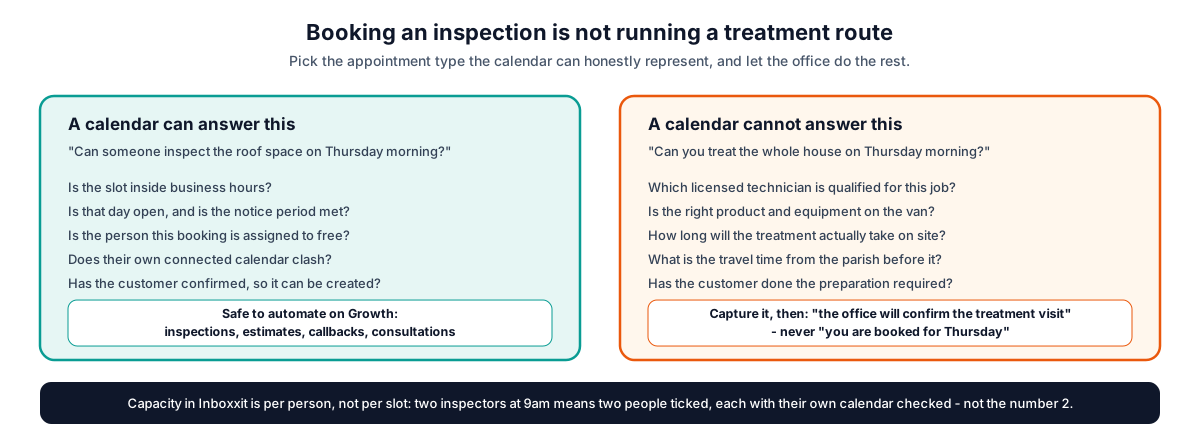
It is worth being precise about capacity, because the setting is commonly misread. Inboxxit's control is "Appointments each person takes at once" — it is per person, not per slot, and it accepts one to twenty. Two inspectors taking consultations at 9am is not the number 2 in that box; it is two people ticked under "Who takes bookings", each with their own connected calendar checked before their name goes on a visit. With nobody ticked, every booking goes to the owner.
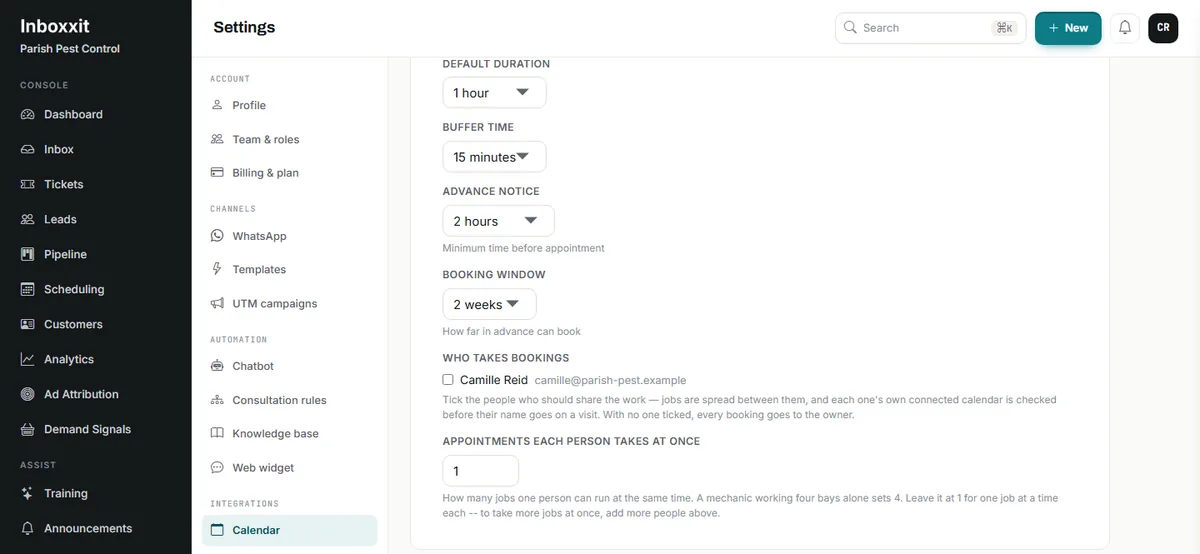
What the calendar cannot do is dispatch. It does not know which licensed technician is qualified for the job, what product and equipment are on the van, how long the treatment will actually run, the travel time from the parish before it, or whether the customer has completed the preparation the job requires. For a small pest-control company the clean first booking type is therefore an inspection, estimate, callback or consultation with simple availability rules. The office confirms the treatment visit afterwards.
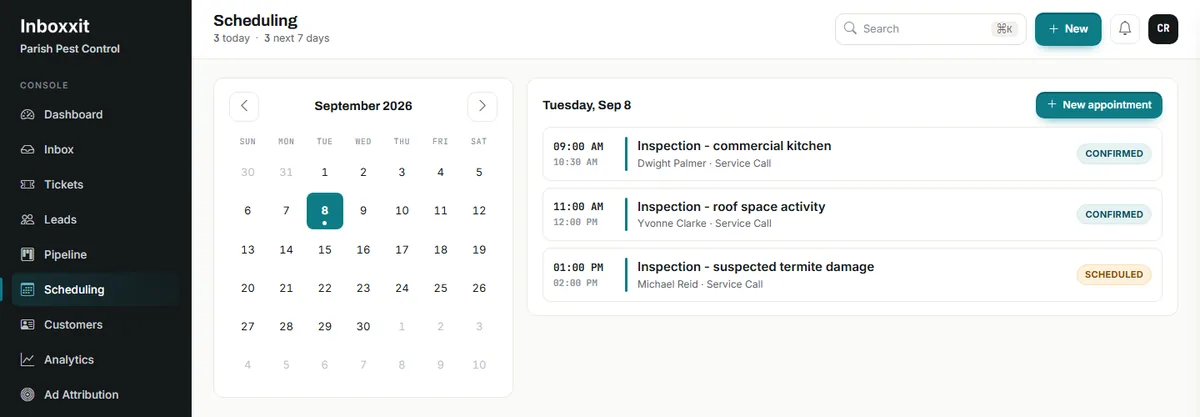
If the business already runs dense recurring routes, technician skill matrices, service histories and chemical reporting, keep the specialist pest-control platform as the operational system and define how enquiries reach it. Whichever tools you choose, check that they actually serve your country — support hours, payment methods and local availability — before committing. What you must not do is run two calendars and hope the team remembers which one is real.
Website chat, WhatsApp or telephone?
Choose the channel before choosing the product.
| Where the enquiry arrives | What fits | What to check first |
|---|---|---|
| Website visitors who leave without contacting you | The $39 Website Chatbot plan: approved answers, lead capture, intent scoring, shared inbox and pipeline | It does not include booking, WhatsApp, voice notes, document upload, automated follow-up or ad-conversion reporting |
| Customers who message the number on the van | WhatsApp, from Growth, using the business's own WhatsApp Business number through Meta's official route | Setup and Meta approval are required, and outside the customer-service window you need an approved template — see Meta's messaging guidance. Do not plan follow-up as unrestricted outbound messaging |
| Missed telephone calls | A phone-first AI receptionist or a human answering service | Inboxxit does not answer telephone calls. Confirm transfer behaviour, booking rules, pest-control knowledge and whether the product serves your country |
| Everything, in one operational system | A pest-control management platform for dispatch, routes, recurring service, technician records and billing | More implementation and cost; confirm whether website and WhatsApp enquiries still need a front layer |
The question is not which product has the most features. It is where the enquiry arrives, and which operating decision the system has to finish. Buying an enterprise platform to fix five unanswered website chats is too much. Buying a website chatbot to run fifteen technician routes is not enough.
Which Inboxxit plan fits a pest-control business?
Prices are in US dollars and were checked against the live pricing page on 8 September 2026.
| Plan | Best pest-control use | Monthly package |
|---|---|---|
| Website Chatbot | Website questions, service-area checks, lead capture, intent scoring, shared inbox and pipeline | $39 founder rate, normally $59. Website only. 500 conversations, 1,000 AI replies, up to 3 team members |
| Growth | Everything above plus in-chat inspection booking, calendar connection, knowledge base, voice notes, automated follow-up, conversion reporting and WhatsApp | $79, normally $99. 3,000 conversations, 4,000 AI replies, up to 5 team members |
| Professional | Higher volume, more seats, payment links, API access and advanced analytics | $149, normally $199. 10,000 conversations, 10,000 AI replies, up to 15 team members |
The entry plan is the lower-risk pilot: it answers the first operational question, which is whether the website can handle routine pest-control enquiries and give the team a better follow-up queue. It does not include booking or WhatsApp. If the chatbot needs to schedule an inspection inside the conversation, Growth is the relevant plan.
One detail worth knowing on the entry plan: it cannot be trained on uploaded documents or a website sync — that knowledge base begins at Growth. What it can do is show you the gaps. When the assistant is not confident, it records the unanswered question for review, and an owner or admin can approve the answer from the queue. On the $39 plan that review queue is the training mechanism, and for a business writing its approved-answer list for the first time it is arguably the more useful one, because every entry comes from a question a real customer actually asked.
There is no free trial. Payment is taken at signup and new customers have a 30-day money-back guarantee. Voice notes are included from Growth: 300 a month on Growth, 1,000 on Professional.
A launch test worth running before you switch it on
Give the chatbot one first job — new website enquiries, or inspection requests — rather than launching treatment education, complaints, recurring-service changes and dispatch at once. Then write the three urgency clocks as separate rules, and make sure the buying-intent score is not being used as a hazard score or a dispatch instruction.
Build the approved-answer map and remove expired prices and promotions. Build the never-answer map, and put the licensed operator's exact wording in each rule's reply field. Assign a price mode to every service; if the team cannot agree the rule, the chatbot should not be answering that price question yet. Make the service-area logic explicit, including what happens when an address falls outside the normal area or attracts a travel charge.
Have the licensed operator approve the safety handoff wording, with the correct local emergency and poison-information route for the country you operate in. In Jamaica, the Caribbean Poison Information Network is the regional poison-information service and the Pesticides Control Authority links to it; confirm the current numbers with your operator rather than copying any from an article, including this one. An overseas emergency number in a Jamaican workflow is worse than no number at all.
Then test the awkward questions, because the easy ones were never the risk. Ask about an old neighbour's price. Ask what the insect is. Ask whether the treated room is safe for a baby. Ask what to spray in the meantime. Report a child coughing after handling something. Ask for a parish you do not serve. Ask about a commercial kitchen. Ask for someone within the hour. Dispute a warranty. Ask for a service you do not offer. The useful tests are the ones the chatbot should refuse cleanly.
Review the first month before expanding: unanswered questions, wrong assumptions, stale prices, handoff delays, duplicate bookings, out-of-area leads and whether staff actually followed up. Improve the approved information before adding more automation.
Who should choose it, and who should not
Choose Inboxxit when the problem is at the front door — visitors ask routine questions, messages arrive while the team is treating a property, good enquiries go quiet, and nobody can see which prospects still need attention. Start on the Website Chatbot plan and move to Growth when booking, WhatsApp, a knowledge base, follow-up or attribution solves a problem you can name.
Choose or keep a specialist field-service system when the work depends on routes, technicians, recurring contracts, chemical and inspection records, inventory or billing. Choose a phone-first receptionist when missed telephone calls are the actual leak. And keep a person close whenever identification, treatment, safety or a dispute enters the conversation.
The chatbot does not need to behave like an exterminator to earn its place. It needs to stop a real customer meeting silence, take a clean brief, refuse the things a licensed operator answers for, and make sure somebody owns the next step.
Compare the current plans or book a 15-minute demonstration and test it with your own awkward questions: one price boundary, one out-of-area enquiry, one safety handoff, one unknown insect and one route-sensitive booking. If any answer leaves you uneasy about treatment, safety or what the field team can honestly deliver, fix that workflow before you launch.
If you are still deciding what kind of tool you need, start with the WordPress AI chatbot guide for service businesses. If you are weighing a general support widget against a lead-capture front desk, the Tidio comparison covers that trade-off, and the plumbing guide works through the same decisions for a trade where the safety route runs through the utilities rather than the regulator.
What a pest-control chatbot must never answer
Six requests a pest-control front desk should refuse and route to a licensed operator, and where each refusal has to come from.
-
Naming the pest
Identification from a description or photograph belongs to a licensed operator, after seeing the site. Write it as your own rule.
-
Recommending a product or dose
Any product, dose or home mixture. Write it as your own rule.
-
Re-entry and occupant safety
When a treated area is safe again, or safe for a child, pet or elderly occupant. Write it as your own rule.
-
Assessing symptoms after contact
Anyone unwell after handling a product goes to the safety route, not the sales conversation. Write it as your own rule.
-
Guaranteeing the outcome
Already covered: the shipped guardrails tell the assistant to avoid “guarantee”, “always” and “100%”.
-
Inventing a price
Already covered: a price that is not on file is deferred to a person for an exact quote.
Frequently Asked Questions
Does an AI chatbot work for a pest-control business?
Yes, when it handles administrative enquiries rather than pest-control decisions. It can answer approved questions about services, coverage and hours, capture a lead, keep the conversation on record and move the customer to an inspection or callback. It is less useful when nearly all work arrives by telephone, or when the real need is technician dispatch and route management.
Can Inboxxit identify a pest or recommend a pesticide?
No, and it should not be configured to try. Identification may need a photograph, a sample or a site inspection, and the treatment decision belongs to a licensed operator. Configure a handoff rule so the chatbot records the customer's own description and routes the request to a person. In Jamaica the Pesticides Control Authority licenses pest-control operators, and its consumer guidance tells customers to expect a physical site inspection before the job is assessed.
Will the chatbot invent a price or promise a treatment plan?
It ships with a standing instruction never to invent or guess a price that is not on file, and to defer to a person for an exact quote. It is also told to avoid “guarantee”, “always” and “100%”. Those are controls rather than certainties — Inboxxit's terms state that AI output can be inaccurate and does not replace human judgment — so assign every service a price mode, test the edge cases and keep final quotes with a person.
Can Inboxxit book pest-control appointments?
On Growth and above it can offer and confirm real calendar slots using the internal calendar or a connected Google or Outlook calendar, and it checks the assigned person's own calendar first. That is not route-aware dispatch: it does not know which technician is qualified, what is on the van, how long a treatment will run or the travel time from the previous parish. Inspections, estimates and callbacks are the cleanest first booking types.
How does booking capacity work?
The setting is “Appointments each person takes at once” and it is per person, not per slot, with a range of one to twenty. Two inspectors taking consultations at 9am means two people ticked under “Who takes bookings”, each with their own connected calendar checked before their name goes on a visit — not the number two in the capacity box. With nobody ticked, every booking goes to the owner.
Can a customer send a photograph of the damage?
Over WhatsApp, yes, on Growth and above. The website widget accepts text and voice notes but not images. Either way a photograph is context for a person to look at, not an input to automated pest identification, which Inboxxit does not do.
Does Inboxxit answer telephone calls?
No. Inboxxit covers website chat and, on Growth and above, WhatsApp. A pest-control company whose main leak is missed telephone calls should compare a phone-first AI receptionist or a human answering service, and should check that the product actually serves its country before committing.


